
 News & Insights
Every year, you get the same notification from your PBM: "Here are your formulary changes and here is the member disruption." That's all.
Most plan sponsors absorb the changes, notify their members, and move on. What they don't get is the financial analysis behind why those decisions were made: not the net cost impact, not the tradeoffs that were evaluated, and not the savings (if there even are any).
That's not an oversight. It's how the traditional PBM model was designed.
And it's one of the biggest reasons plans continue missing savings opportunities already sitting inside their own claims data. It's simply because no one is actively evaluating the tradeoffs behind those decisions.
The Formulary You're Using Wasn't Built for You
The "Big 3" PBM formulary is an impressive feat of infrastructure. It covers tens of millions of lives across hundreds of employer and plan relationships. It accommodates an enormous range of clinical needs, negotiates at massive scale, and updates on a predictable cycle.
It also wasn't designed to work for your plan.
A formulary built to work for everyone is rarely optimized for anyone. It's built for the book of business: broad by necessity, not bespoke by design.
When you use an off-the-shelf formulary, you get a strategy built around population-level economics. The biosimilar positions reflect manufacturer relationships negotiated at scale. The highest-rebate drugs tend to stay protected because the rebate revenue is central to how the strategy is structured. The formulary may satisfy broad coverage requirements, but that doesn't mean it's optimized for your plan's clinical priorities, utilization patterns, or financial goals.
Most plans have never fully separated which decisions are theirs and which belong to the model they're operating inside. That's where the opportunity starts.
What's Actually Hiding in Your Claims Data
Most plans assume their claims data is being actively managed. In practice, it's being processed, and there's a significant difference between the two.
When we ran a formulary optimization for a plan whose net costs had grown 28% year over year while claims volume grew just 13%, we found $13.6 million in identified annualized savings, representing 9.8% of the plan's total drug cost.
That gap isn't inflation. It's drug mix.
At Expion, we go through claims data with NDC-level precision, costing every claim against actual contract rates rather than benchmark averages or minimum guarantees to identify savings opportunity. And while this list is not by any means exhaustive, here are some of the most common areas we see showing up in plan after plan:
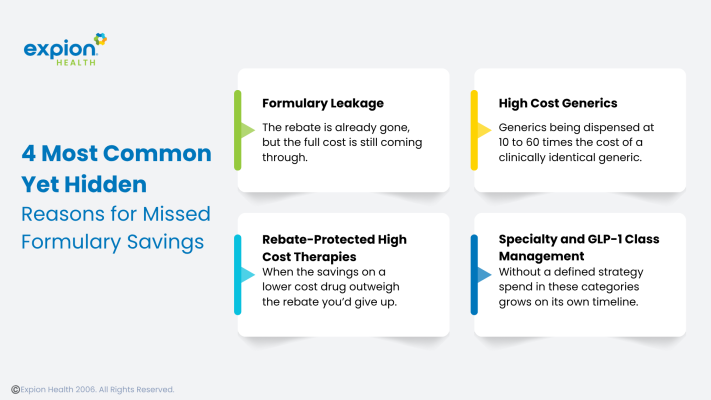
- Formulary Leakage: Most plans have excluded drugs still being dispensed through member overrides or continuation-of-therapy authorizations, sometimes without end dates. The rebate is already gone, but the full cost is still coming through, often with little ongoing clinical justification.
- High-Cost Generics: Within the same drug class, there are often generics being dispensed at 10 to 60 times the cost of another generic that is clinically identical. Clinically, the difference may be negligible. Financially, it often isn't.
- Rebate-Protected High-Cost Therapies: There are drugs on your formulary that your PBM will tell you can't be touched because restricting them would mean losing a significant rebate. But a large rebate doesn't always mean a drug is your lowest-cost option. When you actually run the numbers on what it would cost to cover a clinically equivalent alternative instead, the savings can outweigh the rebate you'd give up.
- Specialty and GLP-1 Class Management: Demand in these categories is reshaping prescription economics faster than annual formulary cycles can respond. Without a defined strategy around sourcing, coverage criteria, and manufacturer assistance, spend in these categories grows on its own timeline, not yours.
The Fiduciary Dimension
Formulary passivity has always carried a financial cost. Increasingly, it carries a fiduciary one, too.
Several high-profile lawsuits have been brought by plan members alleging that their employers failed to exercise fiduciary responsibility over the pharmacy benefit—not that bad decisions were made directly, but that the decisions being made on the plan's behalf were never actively scrutinized.
Most of these cases have been settled or dismissed, but the direction of scrutiny is clear and the standard is rising.
When a member asks why their drug costs more than it did last year, or why a medication they've taken for years suddenly requires an override, plans that actively govern formulary strategy are in a much stronger position to explain and defend those decisions when scrutiny arises.
What Active Formulary Strategy Actually Looks Like
Most plan sponsors don't realize they have more leverage here than they think. You can question your PBM's formulary decisions, demand the financial rationale behind them and make targeted changes without blowing up your entire benefit structure or waiting for your next renewal cycle to force your hand. The most effective changes are often more targeted and achievable than plans realize.
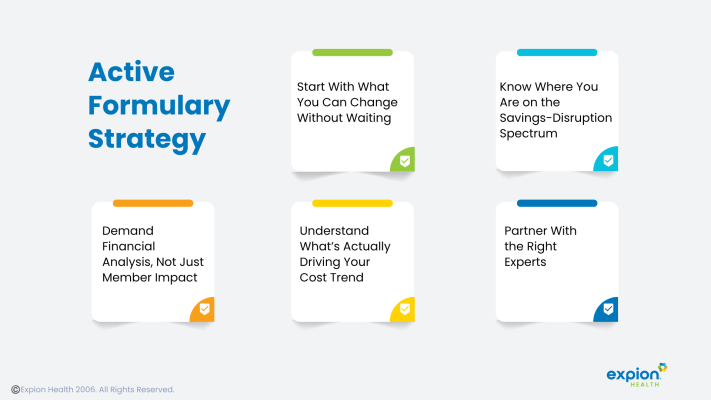
Start With What You Can Change Without Waiting
High-cost generic management doesn't require a renewal cycle, a contract renegotiation, or member disruption. It requires looking at your claims data and identifying where identical drugs are being dispensed at vastly different costs within the same therapeutic class. This is one of the first places we look in every analysis, and it's consistently one of the fastest opportunities to act on.
Know Where You Are on the Savings-Disruption Spectrum
More aggressive formulary changes yield more savings but could also mean more member disruption. The plans that tend to underinvest in formulary strategy are often the ones closest to a difficult choice: raise premiums, cut benefits, or absorb trend. If that's where you are, there may be options that look more disruptive on paper than they are in practice. Always do the math before a decision is made.
Demand Financial Analysis, Not Just Member Impact
When formulary changes arrive, ask for the reasoning behind each decision: projected savings, net cost impact, and the tradeoffs that were evaluated. Understanding the financial logic behind your formulary is a reasonable expectation, and it's the starting point for being able to engage with those decisions rather than simply execute on them.
Understand What's Actually Driving Your Cost Trend
If your net cost is growing faster than your claims volume, the real gap is in your drug mix. The good news is that drug mix is shapeable. Knowing which therapeutic classes and which specific drugs are responsible for that gap is the foundation for taking action.
Partner With the Right Experts
The plans that find the most opportunity in their claims data aren't necessarily the largest or most sophisticated. They're the ones working with partners who have aligned incentives to look deeper. At Expion, we built our clinical and analytic infrastructure specifically to find what standard formulary management leaves behind and to turn that into a strategy your plan actually controls. That's exactly the kind of active, data-driven strategy we were built to support.
The Next Contract Cycle is Closer Than It Seems
By the time your next formulary update arrives, many of the decisions shaping your pharmacy spend will already have been made.
That's the problem with waiting.
Every month without deeper claims analysis is another month where high-cost generics, rebate-protected therapies, formulary leakage, specialty spend and GLP-1 utilization can continue moving without enough scrutiny. The opportunity is not just to catch those issues after the fact. It is to build a pharmacy strategy with enough visibility and flexibility to act before the next cycle dictates your options.
Plans do not need to rebuild their entire pharmacy benefit to take more control. But they do need to stop treating formulary strategy as something that happens to them.
Waiting for your PBM to tell you what changed isn't a strategy. Building the visibility to challenge, shape and act on those decisions is.
For the teams building pharmacy forward
Get the Expion Health® perspective on the trends, decisions, and market shifts redefining how pharmacy value is created.


Move beyond the pharmacy black box
See how Expion helps organizations build pharmacy strategies with more visibility, flexibility and control from the start.