
 News & Insights
This month’s edition provides a focused review of newly approved and recently launched therapies. Expion Health monitors these developments closely to assess clinical relevance, therapeutic positioning, and potential implications for payers, providers, and patients.
Indication
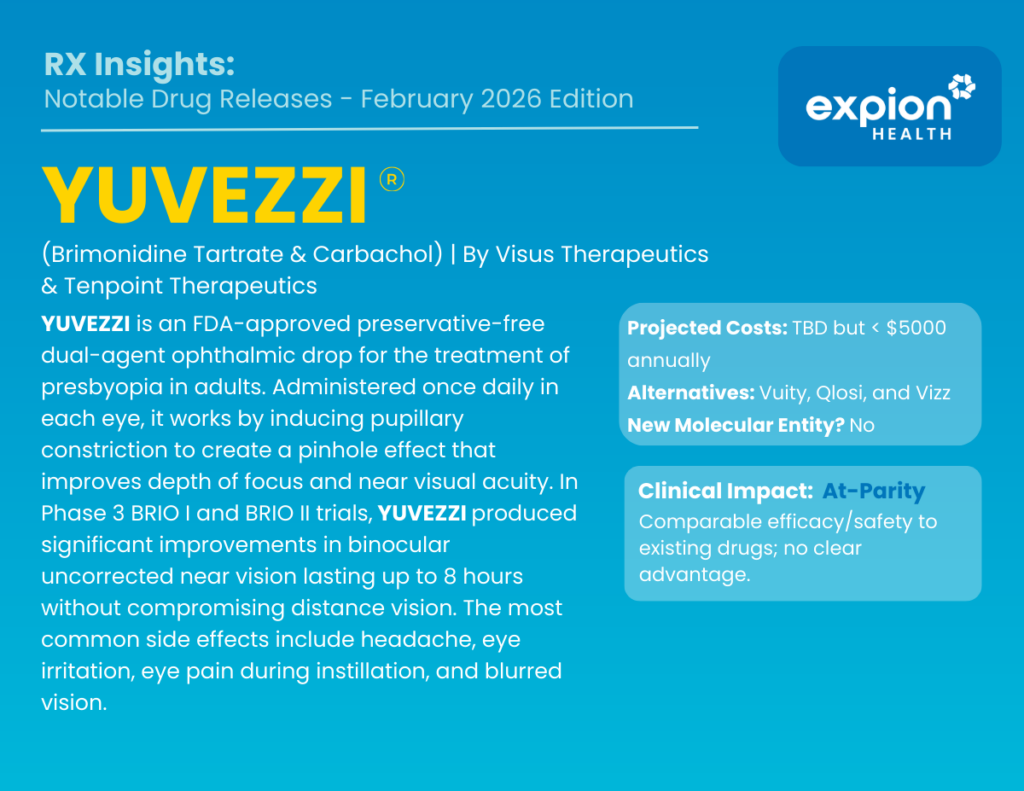
YUVEZZI (carbachol and brimonidine tartrate) is the first and only preservative-free dual-agent ophthalmic drop approved for the treatment of presbyopia in adults.
Dosage and Administration
YUVEZZI is supplied as a 2.75%/0.1% ophthalmic solution and is administered once daily in each eye using a single-dose vial.
Patients should remove contact lenses prior to administration and wait at least 10 minutes before reinserting them. If using other ophthalmic medications, doses should be separated by at least 5 minutes. To prevent contamination, avoid touching the dropper tip to the eye or surrounding surfaces. A single vial may be used for both eyes and should be discarded immediately after use.
Warnings and Precautions
Common adverse reactions include headache, eye irritation, eye pain during instillation, and blurred vision.
YUVEZZI should be used with caution in patients with cerebrovascular insufficiency or cardiovascular disease. It is contraindicated in patients with iritis due to the potential for worsening ocular inflammation.
Mechanism of Action
YUVEZZI works by inducing pupillary constriction, creating a pinhole effect that improves depth of focus and near visual acuity, allowing patients to better see close objects.
Disease Background
Presbyopia is an age-related vision condition that occurs when the eye’s crystalline lens loses its ability to change shape to focus on near objects. Normally, contraction of the ciliary muscle allows the lens to become more rounded for near vision. With presbyopia, this accommodative process diminishes, leading to difficulty reading and performing close-up tasks.
Clinical Data
FDA approval was supported by two Phase 3 clinical trials (BRIO I and BRIO II).
- BRIO I: Demonstrated superior near-vision improvement with the combination therapy compared with each individual active component.
- BRIO II: Met all primary endpoints, showing statistically significant three-line or greater improvement in binocular uncorrected near visual acuity lasting up to 8 hours, without loss of one line or more of distance visual acuity.
YUVEZZI was also well tolerated, with no serious adverse events reported across more than 72,000 monitored treatment days in the BRIO II study.
Indication
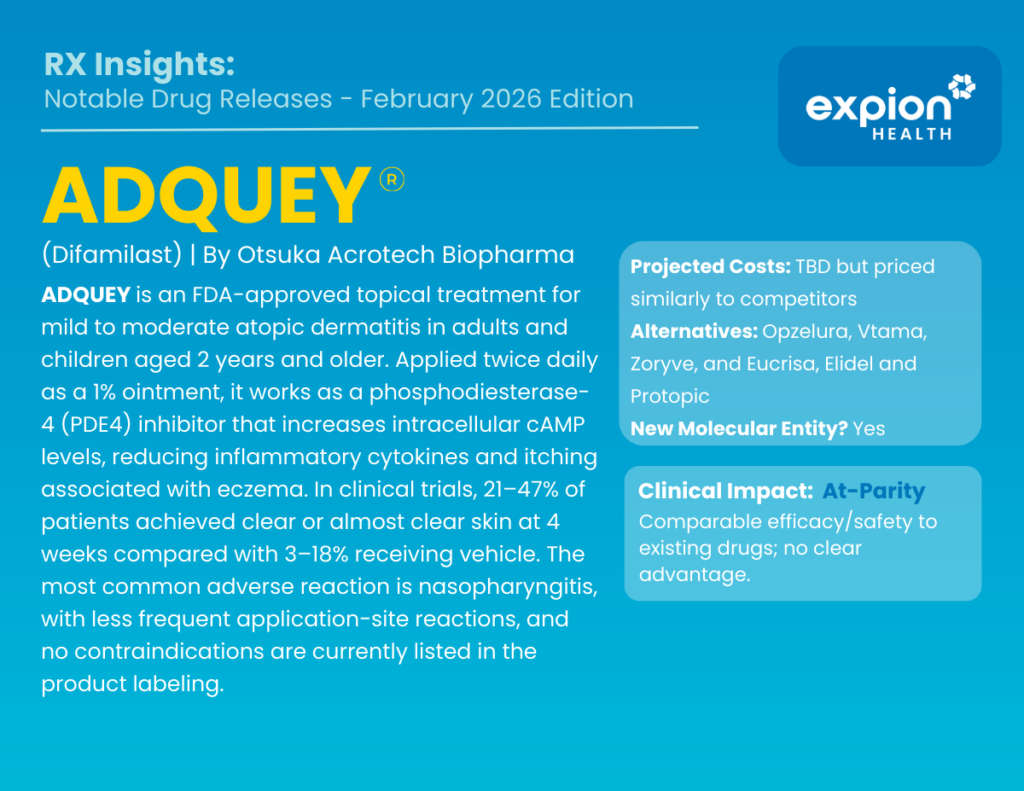
ADQUEY (difamilast) is FDA approved for the topical treatment of mild to moderate atopic dermatitis (AD) in adults and pediatric patients aged 2 years and older.
Dosage and Administration
ADQUEY is supplied as a 1% topical ointment and should be applied twice daily to affected areas and rubbed in completely. It is available in 27 g and 85 g tubes.
Warnings and Precautions
The most reported adverse reaction (1–10%) is nasopharyngitis (6%). Less common adverse reactions (<1%) include application-site folliculitis, contact dermatitis, application-site rash, and molluscum contagiosum.
Mechanism of Action
ADQUEY is a phosphodiesterase-4 (PDE4) inhibitor that increases intracellular cyclic adenosine monophosphate (cAMP) levels. This results in decreased production of pro-inflammatory cytokines and chemokines, helping reduce inflammation and itching associated with atopic dermatitis.
Disease Background
Atopic dermatitis, commonly known as eczema, is a chronic inflammatory skin disease characterized by dry skin, intense itching, rash, skin cracking, and discoloration, which may lead to thickened skin and secondary infections. The condition results from skin barrier dysfunction and immune dysregulation, with type 2 cytokines such as IL-4 and IL-13 playing key roles in its pathogenesis.
AD often begins in early childhood, though it may persist into adulthood or develop later in life. Symptoms can significantly impact quality of life, contributing to sleep disturbances, anxiety, and depression. AD frequently occurs alongside other atopic conditions such as asthma, allergic rhinitis, and food allergies.
Clinical Data
The efficacy and safety of ADQUEY were evaluated in three multicenter, randomized, double-blind, vehicle-controlled trials involving 612 adult and pediatric patients aged ≥2 years with mild to moderate atopic dermatitis. Patients applied ADQUEY 1% ointment or vehicle twice daily for at least 4 weeks. The primary endpoint was Investigator’s Global Assessment (IGA) success at Week 4, defined as clear or almost clear skin (IGA 0 or 1) with at least a 2-grade improvement from baseline.
- IGA success rates: 21–47% with ADQUEY vs 3–18% with vehicle
Clinical improvements were observed in both adult and pediatric populations, and ADQUEY was generally well tolerated. Long-term open-label studies up to 52 weeks showed a consistent safety profile with no new safety concerns.
Indication
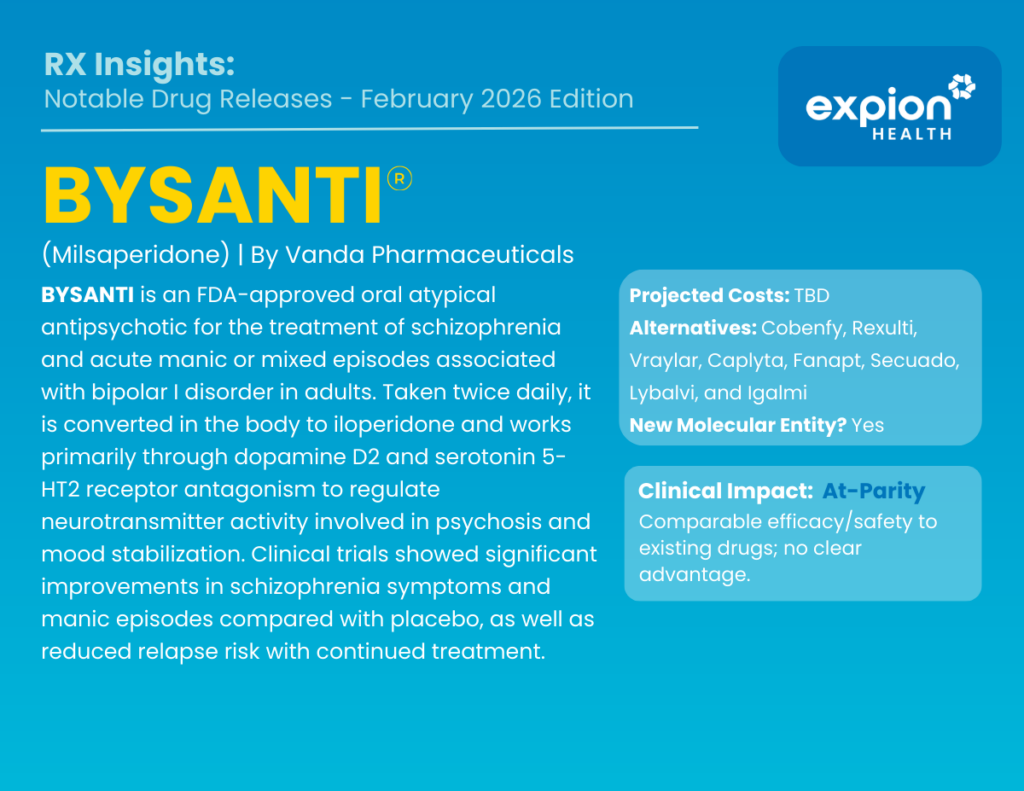
BYSANTI (milsaperidone) is FDA approved for the acute treatment of manic or mixed episodes associated with bipolar I disorder and for the treatment of schizophrenia in adults.
Dosage and Administration
BYSANTI is administered orally twice daily with or without food. It comes in doses of 1mg, 2mg, 4mg, 6mg, 8mg, 10 mg, and 12 mg tablets, as well as titration packs. To minimize the risk of orthostatic hypotension, gradual dose titration is recommended before reaching maintenance doses.
Recommended maintenance doses:
- Schizophrenia: 6–12 mg twice daily
- Bipolar mania: 12 mg twice daily
The active ingredient, milsaperidone, is rapidly converted in the body to iloperidone.
Warnings and Precautions
BYSANTI carries a Boxed Warning for increased mortality in elderly patients with dementia-related psychosis.
Common adverse reactions include tachycardia, dizziness, dry mouth, elevated liver enzymes, nasal congestion, weight gain, hypotension, and somnolence.
Serious potential adverse reactions may include QTc prolongation, neuroleptic malignant syndrome, tardive dyskinesia, metabolic changes (hyperglycemia and dyslipidemia), seizures, orthostatic hypotension, leukopenia, hyperprolactinemia, impaired thermoregulation, priapism, cognitive impairment, and intraoperative floppy iris syndrome. Severe allergic reactions such as anaphylaxis and angioedema have also been reported.
Mechanism of Action
BYSANTI is an atypical antipsychotic. Its therapeutic effects are thought to result primarily from dopamine D2 and serotonin 5-HT2 receptor antagonism, helping regulate neurotransmitter pathways involved in psychosis and mood stabilization.
Disease Background
Schizophrenia is a chronic psychiatric disorder characterized by positive symptoms (hallucinations and delusions), negative symptoms (social withdrawal and reduced emotional expression), and cognitive impairment affecting memory, attention, and decision-making. The illness can significantly impair daily functioning and independence.
Bipolar I disorder is a chronic mood disorder marked by recurrent manic and depressive episodes that affect mood, energy, and behavior. Manic episodes may include elevated mood, decreased need for sleep, impulsivity, and sometimes psychosis, while depressive episodes involve low mood, fatigue, and impaired concentration. Both conditions often require long-term pharmacologic management.
Clinical Data
Schizophrenia
Efficacy was demonstrated in three well-controlled clinical trials in adults:
- Study 1 (6 weeks, n=706): Flexible doses of iloperidone (12–24 mg/day) significantly improved BPRS total scores compared with placebo.
- Study 2 (4 weeks, n=604): Fixed-dose iloperidone 24 mg/day significantly improved PANSS total scores compared with placebo, with efficacy comparable to ziprasidone.
- Study 3 (randomized withdrawal, n=303): Patients who continued iloperidone experienced longer time to relapse compared with those switched to placebo, supporting maintenance of effect.
Overall, BYSANTI improved schizophrenia symptoms and reduced relapse risk with continued treatment.
Bipolar I Disorder
Efficacy for acute manic or mixed episodes was demonstrated in a 4-week randomized, double-blind, placebo-controlled study (n=392).
- Patients received iloperidone 12 mg twice daily (24 mg/day) following titration. Manic symptoms were assessed using the Young Mania Rating Scale (YMRS).
- Patients receiving iloperidone showed significant improvement in YMRS scores compared with placebo at Day 28.
Treatment response was consistent across age, sex, and racial subgroups.
Indication
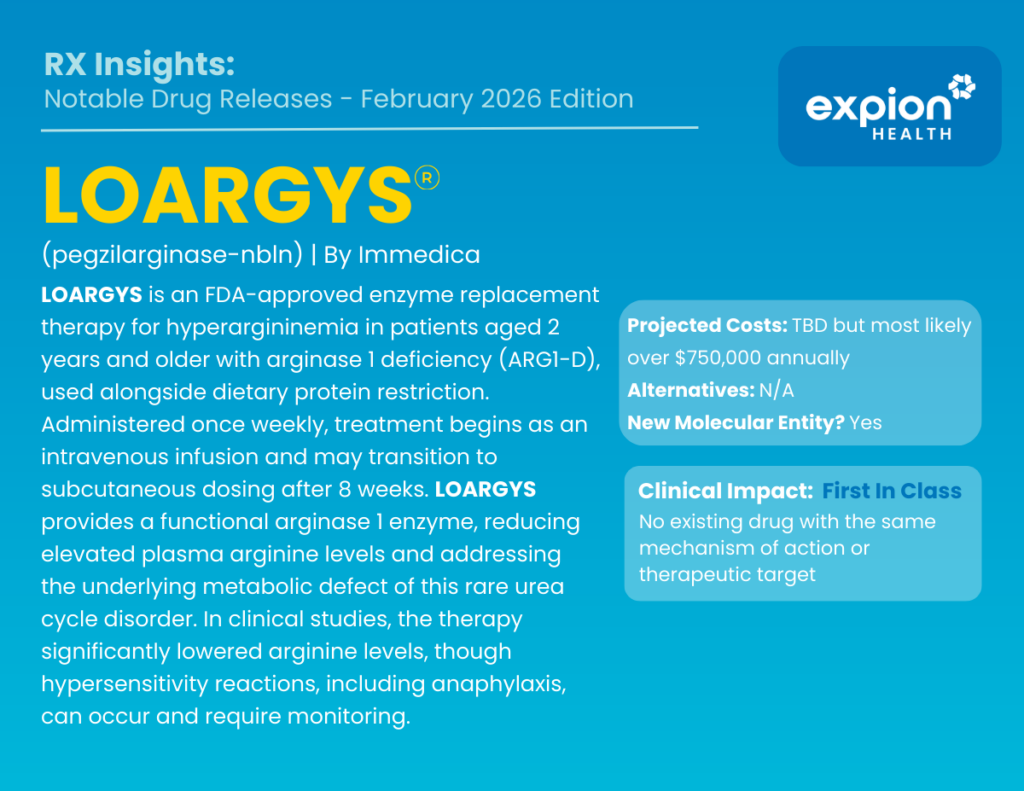
LOARGYS (pegzilarginase-nbln) is FDA approved for the treatment of hyperargininemia in adults and pediatric patients aged 2 years and older with arginase 1 deficiency (ARG1-D), used in conjunction with dietary protein restriction.
Dosage and Administration
LOARGYS should be initiated under the supervision of a healthcare provider experienced in managing hypersensitivity reactions. Treatment should begin in a healthcare setting with appropriate monitoring and access to resuscitation equipment.
The recommended starting dose is 0.1 mg/kg administered intravenously once weekly, with a maximum recommended dose of 0.2 mg/kg once weekly. Baseline plasma arginine levels should be obtained prior to initiating therapy. After 8 weeks of weekly IV treatment, patients may transition to once-weekly subcutaneous administration at the same dose. Pre-medication with antihistamines may be considered to reduce hypersensitivity risk.
Warnings and Precautions
The most common adverse reactions (>10%) include vomiting, pyrexia, infusion-related reactions, and constipation.
LOARGYS carries a warning for hypersensitivity reactions, including anaphylaxis. If a severe hypersensitivity reaction occurs, treatment should be discontinued immediately and appropriate medical management initiated, including administration of epinephrine when indicated. Injection-site reactions may occur with subcutaneous administration.Mechanism of Action
LOARGYS provides an exogenous source of the human arginase 1 enzyme, replacing deficient enzyme activity in patients with ARG1-D. By restoring arginase function, the therapy reduces elevated plasma arginine levels by converting arginine into urea and ornithine, helping correct the underlying metabolic imbalance.
Disease Background
Arginase 1 deficiency (ARG1-D) is a rare inherited urea cycle disorder caused by deficiency of the arginase enzyme, which catalyzes the final step of the urea cycle. The resulting elevation of plasma arginine leads to progressive neurological complications.
Symptoms typically emerge in early childhood and include spasticity, loss of ambulation, developmental delay, cognitive impairment, seizures, and behavioral changes. Although severe neonatal hyperammonemia is less common than in other urea cycle disorders, patients may experience episodic or chronic elevations in ammonia, which can further worsen neurological injury.
Clinical Data
The safety and efficacy of LOARGYS were primarily evaluated in a randomized, double-blind, placebo-controlled trial (Trial 1) involving 32 pediatric and adult patients aged 2–28 years with ARG1-D.
- 21 patients received LOARGYS intravenously once weekly (up to 0.2 mg/kg) for 24 weeks
- 11 patients received placebo
Findings showed pegzilarginase significantly reduced plasma arginine levels compared with placebo at week 24 (mean absolute change treatment difference, -312 [95% CI, -384, -239]; P <.0001; mean percent change treatment difference, -72% [95% CI, -89, -55]; P <.0001). Additionally, 90% of the pegzilarginase arm achieved target plasma arginine levels (<200μM) and normalized levels vs 0% of the placebo arm.
Additional safety data were obtained from a Phase 1 open-label study (Trial 2) and an open-label extension (Trial 3).
Across clinical studies:
- Hypersensitivity reactions occurred in 13% of patients
- The risk was higher in patients who developed anti-drug antibodies (42% vs 3%)
- Injection-site reactions occurred in 14% of patients during subcutaneous administration in extension studies
These findings demonstrate that LOARGYS provides a targeted enzyme replacement approach for reducing plasma arginine levels in ARG1-D while maintaining a manageable safety profile with appropriate monitoring.
For the teams building pharmacy forward
Get the Expion Health® perspective on the trends, decisions, and market shifts redefining how pharmacy value is created.



Move beyond the pharmacy black box
See how Expion helps organizations build pharmacy strategies with more visibility, flexibility and control from the start.