This month’s edition provides a focused review of newly approved and recently launched therapies. Expion Health monitors these developments closely to assess clinical relevance, therapeutic positioning, and potential implications for payers, providers, and patients.
Indication
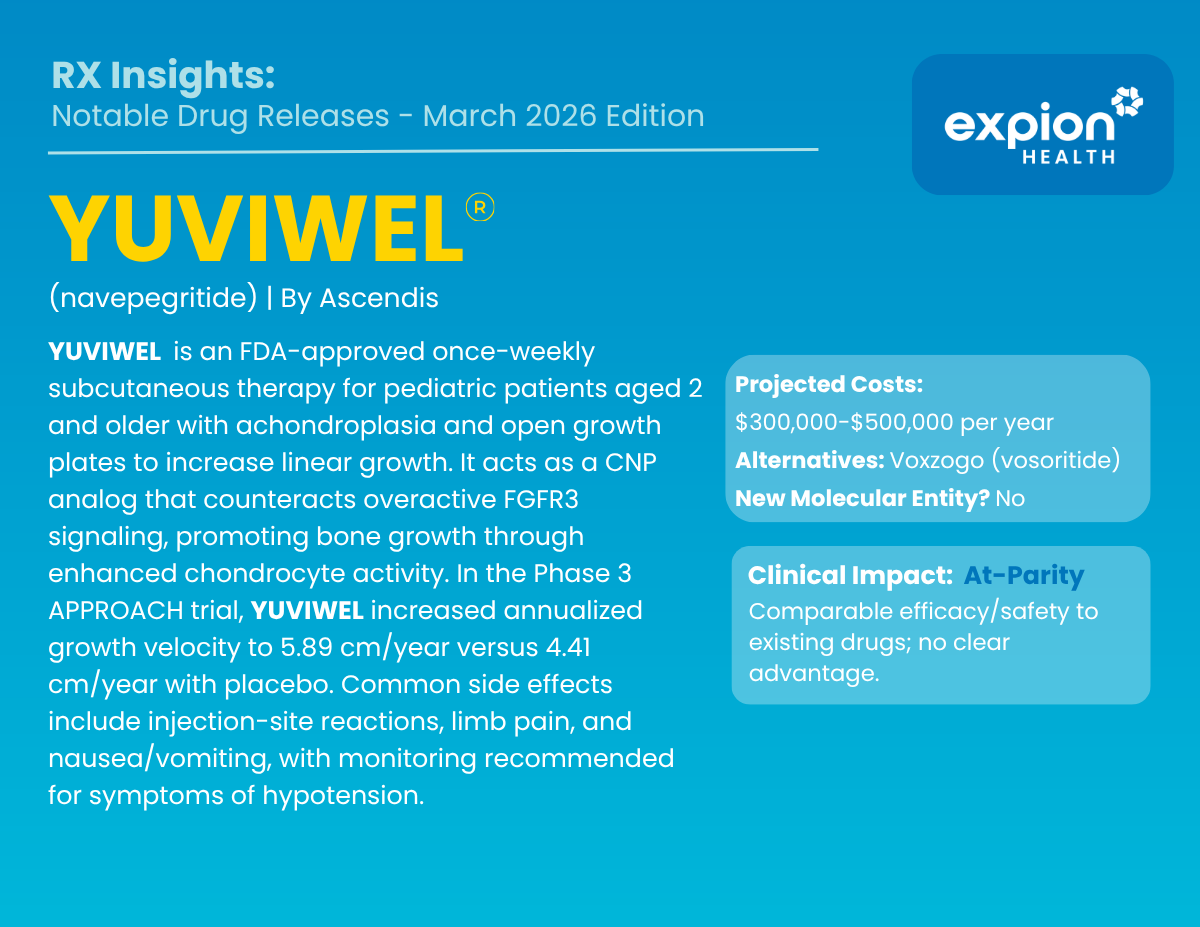
YUVIWEL (navepegritide) is FDA approved to increase linear growth in pediatric patients aged 2 years and older with achondroplasia and open epiphyses.
Dosage and Administration
YUVIWEL is administered as a once-weekly subcutaneous injection, with dosing based on body weight. Growth should be periodically monitored, and dosing adjusted accordingly. Treatment should be discontinued when growth potential is reached, as indicated by epiphyseal closure.
Warnings and Precautions
The most common adverse reactions include injection-site reactions, limb pain, and nausea/vomiting. Patients should be advised to seek medical attention if they experience symptoms of hypotension, such as dizziness, fatigue, or nausea/vomiting.
Mechanism of Action
YUVIWEL is a C-type natriuretic peptide (CNP) analog that binds to natriuretic peptide receptor-B (NPR-B), increasing intracellular cyclic guanosine monophosphate (cGMP) and inhibiting the MAPK signaling pathway. In achondroplasia, overactive FGFR3 signaling suppresses bone growth. YUVIWEL counteracts this pathway, promoting chondrocyte differentiation and proliferation and thereby stimulating endochondral bone growth.
Disease Background
Achondroplasia is a rare, autosomal dominant skeletal dysplasia caused by mutations in the FGFR3 gene, leading to impaired cartilage-to-bone conversion and reduced bone growth. It is the most common cause of disproportionate short stature, with a prevalence of approximately 1 in 20,000 births. Clinical features include shortened limbs, limited elbow extension, macrocephaly, and normal intelligence, with an average adult height of approximately 4 feet. Patients may also experience complications such as sleep apnea, obesity, recurrent ear infections, spinal stenosis, and hydrocephalus.
Clinical Data
Approval was supported by the Phase 3 APPROACH trial, a randomized, double-blind, placebo-controlled study evaluating children with achondroplasia.
- Annualized growth velocity:YUVIWEL: 5.89 cm/yearPlacebo: 4.41 cm/yearTreatment difference: +1.49 cm/year (P < 0.001)
In addition to increased growth velocity, YUVIWEL demonstrated improvements in skeletal alignment and proportionality, including tibial-femoral angle and limb ratios. The safety profile was favorable, with mostly mild adverse events and no treatment-related serious adverse events observed during the study.
Indication
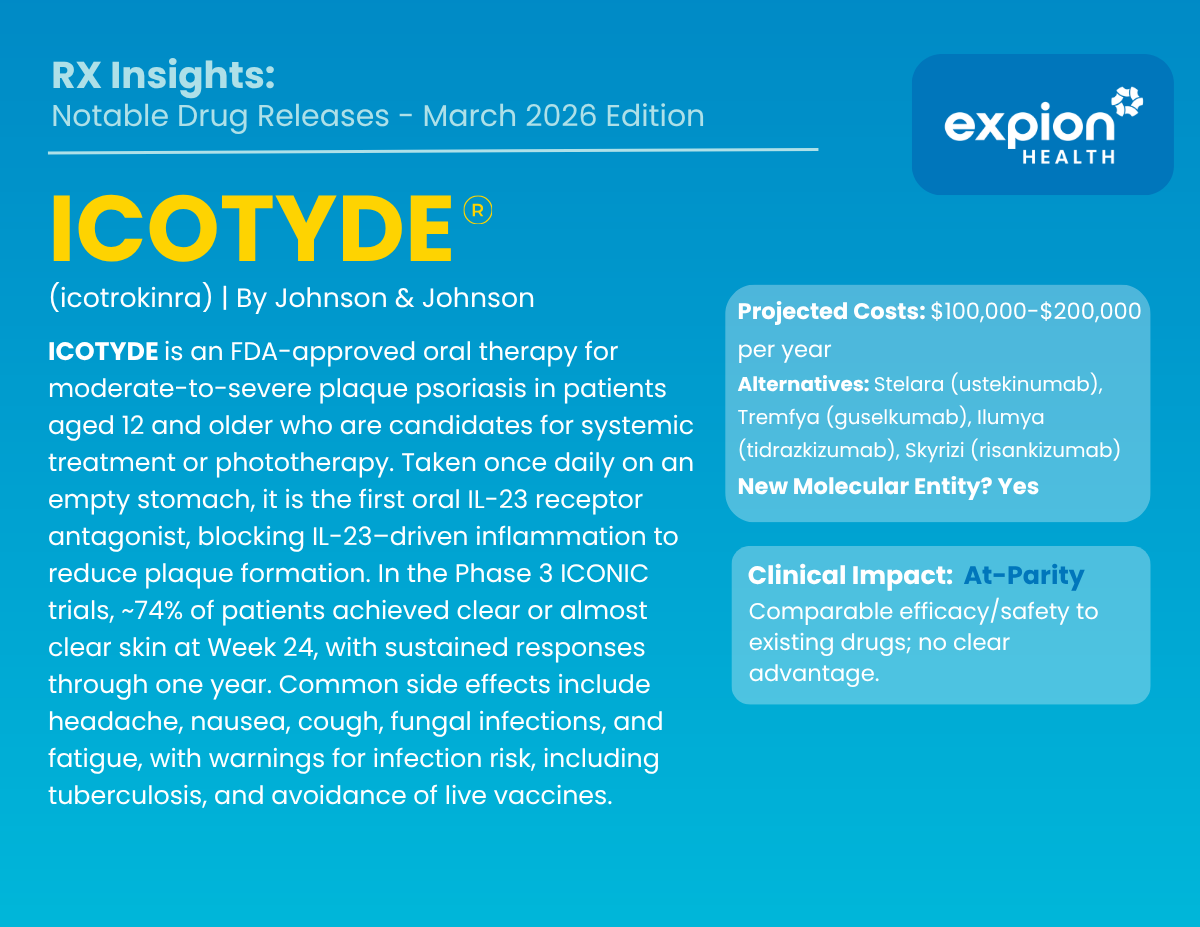
ICOTYDE (icotrokinra) is indicated for the treatment of moderate-to-severe plaque psoriasis in adults and pediatric patients ≥12 years of age who weigh at least 40 kg and are candidates for systemic therapy or phototherapy.
Dosage and Administration
The recommended dose is 200 mg orally once daily, taken on an empty stomach with water upon waking. Patients should wait at least 30 minutes before eating. Tablets may be dispersed in water for patients who have difficulty swallowing.
Warnings and Precautions
ICOTYDE may increase the risk of infections. Treatment should be avoided in patients with active infections and discontinued if a serious infection develops. Patients should be evaluated for tuberculosis prior to initiation and monitored during therapy. Live vaccines should be avoided. Common adverse reactions (≥1%) include headache, nausea, cough, fungal infections, and fatigue.
Mechanism of Action
Icotrokinra is a selective interleukin-23 receptor (IL-23R) antagonist that inhibits IL-23–mediated inflammatory signaling. By blocking IL-23/IL-23R interaction, it reduces downstream proinflammatory cytokine release. ICOTYDE is the first oral agent targeting this pathway, whereas other IL-23–directed therapies are injectable.
Disease Background
Plaque psoriasis is a chronic, immune-mediated inflammatory skin disease characterized by keratinocyte hyperproliferation and formation of thick, scaly plaques. It accounts for approximately 80–90% of psoriasis cases and affects over 7.5 million adults in the United States. Disease severity is based on body surface area involvement, and approximately 20–30% of patients have moderate-to-severe disease requiring systemic treatment. Psoriasis is associated with significant comorbidities, including cardiovascular disease, metabolic disorders, and psoriatic arthritis, contributing to overall disease burden.
Clinical Data
ICOTYDE was evaluated in the Phase 3 ICONIC clinical program, including randomized, double-blind, placebo- and active-controlled trials.
- In the ICONIC-LEAD trial (N=684), ~74% of patients achieved clear or almost clear skin (IGA 0/1) at Week 24
- ICONIC-ADVANCE 1 and 2 demonstrated superiority versus placebo and deucravacitinib for PASI 90 and IGA 0/1 endpoints
- Long-term data (ICONIC-TOTAL) showed sustained responses through Week 52, with 67% achieving clear or almost clear skin
High response rates were also observed in difficult-to-treat areas, including scalp (72%) and genital psoriasis (85%), supporting durable efficacy and a favorable safety profile for once-daily oral therapy.

Indication
LYNAVOY (linerixibat) is indicated for the treatment of cholestatic pruritus associated with primary biliary cholangitis (PBC) in adults.
Dosage and Administration
The recommended dose is 40 mg orally twice daily. Tablets should be swallowed whole at least 30 minutes before food or beverages (other than water).
Warnings and Precautions
LYNAVOY may cause elevations in liver enzymes and deficiencies in fat-soluble vitamins. It should not be used in patients with severe liver impairment or those with a history of significant hepatic complications (e.g., variceal bleeding, ascites, or hepatic encephalopathy). Common adverse reactions include diarrhea, headache, abdominal pain, nausea, dizziness, bloating, indigestion, and elevated liver enzymes.
Mechanism of Action
Linerixibat is a reversible inhibitor of the ileal bile acid transporter (IBAT). By reducing bile acid reabsorption in the intestine, it lowers circulating bile acids and decreases signaling pathways associated with pruritus.
Disease Background
Cholestatic pruritus is a severe itching condition caused by the accumulation of bile acids in patients with PBC, a chronic autoimmune liver disease. Symptoms can be debilitating and are often associated with sleep disturbance, fatigue, and reduced quality of life.
Clinical Data
FDA approval was supported by the Phase 3 GLISTEN trial (n=237), a 24-week, randomized, placebo-controlled study. LYNAVOY demonstrated rapid (as early as Week 2) and sustained reductions in pruritus and itch-related sleep interference compared with placebo, meeting both primary and key secondary endpoints.

Indication
AVLAYAH (tividenofusp alfa-eknm) is an enzyme replacement therapy indicated for the treatment of neurologic manifestations of Hunter syndrome (mucopolysaccharidosis type II [MPS II]) in certain pediatric patients.
Dosage and Administration
AVLAYAH is administered as a once-weekly intravenous infusion in a healthcare setting with appropriate monitoring for hypersensitivity reactions. The recommended starting dose is 3 mg/kg once weekly for pediatric patients weighing at least 5 kg. The dose may be escalated to 7.5 mg/kg during Weeks 5–8 and to 15 mg/kg starting at Week 9, as tolerated.
Warnings and Precautions
AVLAYAH carries a boxed warning for serious hypersensitivity reactions, including anaphylaxis. Therapy should be administered in settings equipped to manage severe allergic reactions. Additional risks include anemia and kidney dysfunction. Common adverse reactions include infusion-related reactions, upper respiratory tract infection, ear infection, fever, cough, vomiting, diarrhea, rash, headache, and nasal symptoms.
Mechanism of Action
AVLAYAH is a fusion protein combining iduronate-2-sulfatase (IDS) with Transport Vehicle™ (TV) technology, enabling delivery across the blood-brain barrier via transferrin receptor targeting. Once delivered to tissues, including the central nervous system, IDS breaks down accumulated glycosaminoglycans (GAGs), reducing substrate buildup responsible for neurologic damage.
Disease Background
Hunter syndrome (MPS II) is a rare X-linked lysosomal storage disorder caused by deficiency of the IDS enzyme. This leads to accumulation of glycosaminoglycans such as heparan sulfate and dermatan sulfate, resulting in progressive multisystem disease, including neurologic impairment. Patients may experience developmental delays, cognitive decline, behavioral changes, joint stiffness, hearing loss, and organ dysfunction.
Clinical Data
FDA approval was supported by a Phase 1/2 study (NCT04251026) in 47 pediatric patients with Hunter syndrome.
- At Week 24, AVLAYAH achieved a 91% average reduction in cerebrospinal fluid (CSF) heparan sulfate levels (95% CI: 89%–92%)
- 93% of patients with available data achieved CSF heparan sulfate levels below the upper limit of normal
These results demonstrate significant biomarker reduction associated with neurologic disease burden, supporting AVLAYAH’s potential to address central nervous system manifestations of MPS II.

Indication
LIFYORLI (relacorilant) is indicated for the treatment of platinum-resistant epithelial ovarian cancer, fallopian tube cancer, and primary peritoneal cancer in adults. It is used in combination with nab-paclitaxel in patients who have received one to three prior systemic regimens, including at least one containing bevacizumab.
Dosage and Administration
The recommended dose is 150 mg orally on the day before, the day of, and the day after each nab-paclitaxel infusion. Capsules should be swallowed whole and taken with food.
Warnings and Precautions
LIFYORLI should not be used in patients requiring systemic glucocorticoids for life-saving indications or in pregnant patients due to embryo-fetal toxicity. Serious adverse reactions include neutropenia, febrile neutropenia, pneumonia, pleural effusion, and fatigue. Common adverse effects include nausea, diarrhea, rash, decreased appetite, and fatigue.
Mechanism of Action
LIFYORLI is a glucocorticoid receptor antagonist that inhibits cortisol signaling. This mechanism enhances the antitumor activity of nab-paclitaxel in platinum-resistant ovarian cancers.
Disease Background
Platinum-resistant ovarian cancer refers to disease that recurs within six months of platinum-based chemotherapy and is associated with poor prognosis and limited treatment options. These cancers originate in the ovaries, fallopian tubes, or peritoneum.
Clinical Data
FDA approval was based on the Phase 3 ROSELLA trial (n=381) in patients with platinum-resistant ovarian cancer.
- Combination therapy reduced the risk of death by 35% compared with nab-paclitaxel alone (HR 0.65; p=0.0004)
- Median overall survival was 16.0 months vs. 11.9 months (Δ 4.1 months)
- A 30% reduction in disease progression was observed (HR 0.70; p=0.008)
These results demonstrate improved survival and disease control with LIFYORLI in a difficult-to-treat population.

Indication
KRESLADI is a gene therapy indicated for pediatric patients with severe leukocyte adhesion deficiency type I (LAD-I) caused by biallelic ITGB2 variants, who do not have an available HLA-matched sibling donor for allogeneic hematopoietic stem cell transplantation.
Dosage and Administration
KRESLADI is administered as a one-time intravenous infusion. Dosing is individualized based on the number of CD34+ cells per kilogram of body weight.
Warnings and Precautions
Serious risks include veno-occlusive disease, engraftment failure (neutrophil or platelet), hypersensitivity reactions, and potential insertional oncogenesis related to the lentiviral vector. Common adverse reactions include mucositis (mouth sores), infections (viral and skin), fever, nausea, vomiting, rash, and skin-related conditions.
Mechanism of Action
KRESLADI works by introducing a functional copy of the ITGB2 gene into the patient’s own hematopoietic stem cells. This enables production of CD18, a key protein required for leukocyte adhesion, migration, and immune response, restoring immune system function.
Disease Background
Leukocyte adhesion deficiency type I (LAD-I) is a rare inherited immunodeficiency caused by mutations in the ITGB2 gene, leading to absent or severely reduced CD18 expression. This impairs white blood cell adhesion and migration, resulting in recurrent, severe infections and life-threatening complications early in life if untreated.
Clinical Data
KRESLADI was evaluated in a single-arm study of nine pediatric patients with severe LAD-I.
- All seven patients with very low baseline CD18 levels achieved increased expression after treatment
- Median CD18 expression reached 54% at 12 months and 50% at 24 months
- CD18 expression was sustained through at least 42 months
- All nine patients showed increased CD11a expression, also sustained long term
These findings demonstrate durable restoration of key immune cell surface proteins associated with improved immune function. Click to view package insert.