
 News & Insights
PBM reform is often framed as a policy story. But for health plans and payers, it’s really a stress test: can their pharmacy strategy withstand a market where pharmacy benefit structures are becoming easier to see, question, and connect back to plan performance?
As new federal requirements, enforcement activity and state-level regulation put more pressure on pharmacy benefit economics, plans are being forced to look harder at how value is created, how decisions are made, and whether their current strategy and infrastructure is built for the market ahead.
The Push for Transparency Is Making Legacy Pharmacy Models Harder to Defend
For years, pharmacy strategies were able to operate with minimal transparency, resembling a black box. Value could be inferred from top-line performance, while the underlying economics, including margin, fees, rebate structures, and manufacturer dollars, remained difficult to see clearly, understand, and challenge.
That model is becoming harder to sustain.
Now, federal legislation, disclosure requirements, enforcement activity, and state-level regulation are all intensifying the pressure for greater visibility into how pharmacy dollars move and how strategy decisions are made.
For plans, the question is no longer whether a pharmacy strategy produces savings. It’s whether it provides savings and value that can be clearly explained, be fully compliant, and confidently defended.
In the old black box economics model, complexity could hide too much. In the emerging glass box environment, value must be visible, traceable, and aligned with the interests of the plan and its members.
In the old black box economics model, complexity could hide too much. In the emerging glass box environment, value must be visible, traceable, and aligned with the interests of the plan and its members.
PBM Reform Is Changing the Way Plans Define Value
For years, lowest net cost has been the dominant way pharmacy performance has been measured. It still matters, but it’s no longer enough on its own.
Plans are under more pressure to address a wider range of questions with increasing levels of detail: What factors drive the plan’s drug utilization and overall drug cost? What pricing underpins the strategy? What does the member experience at the point of sale? How much of the value is truly real? And how well does that value align with plan performance while maintaining member affordability and access?
That shift has major implications for drug coverage and formulary strategy. A formulary may still look strong if viewed narrowly through rebate performance or point-in-time savings. But that same strategy becomes more difficult to justify when it creates higher list-price exposure, a disruptive member experience, or a structure that is difficult to explain when questions arise.
Traditional, off-the-shelf approaches are becoming less effective in a market that expects plans to understand how value is actually created. Models tied more directly to member affordability, including point-of-sale approaches, are becoming harder to ignore. Even where those models are not the right fit in every situation, they reflect a broader change in how value is judged.
The Real Challenge Behind PBM Reform: Prescription Economics
While PBM reform is often framed around industry buzzwords like transparency and disclosure, the more meaningful challenge for plans is how prescription economics are changing underneath the benefit itself.
Prescription economics looks beyond rebates alone and examines the full equation behind how value is created, distributed, and experienced across the pharmacy benefit. That goes beyond list price and rebate value to include copay assistance, direct-to consumer programs, member out-of-pocket cost, and the different ways manufacturer dollars move through the system.
At Expion Health, we see this as the real market shift. The change isn’t just in what gets disclosed, but in how the underlying economics of the benefit itself is evolving.
In a black box pharmacy model, many of those elements could be managed separately. Plans evaluated rebates, copay assistance, and pricing strategy as distinct parts of the benefit, each with its own decisions and tradeoffs.
In today’s glass box environment, those elements are becoming more connected. Manufacturer dollars are moving across multiple channels, from rebates to copay assistance to direct-to-consumer models. As those dynamics shift, the impact of any one decision is no longer isolated. A change in one part of the system can affect cost, access, affordability, and performance somewhere else.
That’s why plans need a clearer view of how these elements interact and a more intentional approach to managing them together. Without that, it becomes harder to understand where value is actually being created and harder to ensue whether strategic decisions are working for both the plan and the member.
PBM Reform Is Raising Fiduciary Expectations for Health Plans
As prescription economics become more visible and more connected, fiduciary expectations are no longer limited to broad oversight. Plans are being asked to show how the pharmacy benefit actually works: how decisions are made, how dollars move, what incentives shape the strategy, and whether those choices serve the interests of the plan and its members.
For plans, that means the conversation goes beyond whether a strategy performs and into whether the underlying decisions, contracts, and financial arrangements can stand up to closer inspection.
That puts new weight on details that have historically been treated like background noise: contract language, reporting requirements, audit rights, fee structures, and visibility into underlying economics. Plans need strategies that are not only effective, but clear in how they work. They need arrangements that are not only financially attractive, but structured in ways that are easier to explain, audit, and defend.
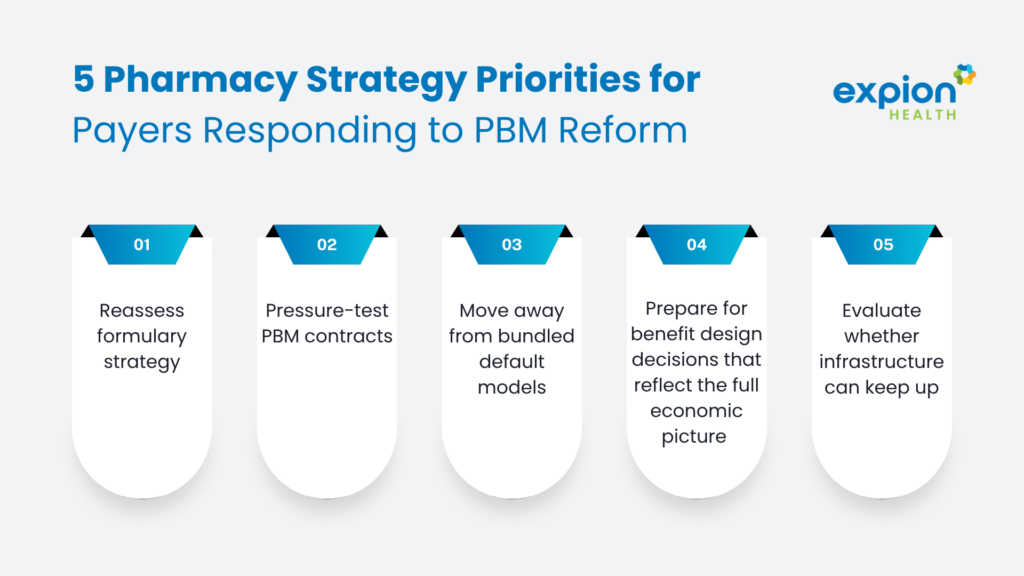
5 Pharmacy Strategy Priorities for Payers Responding to PBM Reform
If PBM reform is exposing the limits of the old model, the response cannot be to wait for every requirement to settle before acting.
Plans should be focusing on a few clear priorities now:
- Reassess formulary strategy. Plans need to understand whether their current approach is balancing net cost, list price, and member affordability and access.
- Pressure-test PBM contracts. Transparency provisions, reporting requirements, audit rights, and visibility into financial arrangements are becoming more important as fiduciary expectations continue to rise.
- Move away from bundled default models. One-size-fits-all pharmacy strategies are becoming less aligned with a market where plans need more control, visibility, and flexibility.
- Prepare for benefit design decisions that reflect the full economic picture. Point-of-sale models and other affordability-linked approaches may not be right in every situation, but they are becoming harder to ignore.
- Evaluate whether infrastructure can keep up. Plans need systems and partners that can provide the visibility, flexibility, and responsiveness required to manage pharmacy strategy in a more demanding environment.
Where PBM Reform Leaves Pharmacy Strategy
PBM reform is still evolving, and not every requirement has been fully defined yet. But the direction for plans is already clear: treating reform as a future reporting requirement is too narrow for the market already taking shape.
The plans that view PBM reform as a compliance exercise will spend the next few years reacting. The ones that understand it as a shift in prescription economics will be better positioned to shape what comes next.
For the teams building pharmacy forward
Get the Expion Health® perspective on the trends, decisions, and market shifts redefining how pharmacy value is created.



Move beyond the pharmacy black box
See how Expion helps organizations build pharmacy strategies with more visibility, flexibility and control from the start.